
Donkey Secondary Antibodies


Biotium Cytokeratin 10(KRT10/844), CF568 conjugate, 0.1mg/mL
This MAb recognizes a protein of 56.5 kDa, identified as cytokeratin 10 (CK10). CK10 is expressed in all suprabasal layers of the epidermis. In the epidermis, expression of CK10 strictly parallels the extent of differentiation; it is absent in the basal layer, appears in the first suprabasal layers and increases in concentration towards the granular layer. However, CK10 is rarely detected in early stages of vulvar squamous carcinomas (tumors less than 2 cm, clinical stage I) regardless of the tumor grade. In larger and more advanced tumors (greater than 2 cm, clinical stages II and III), CK10 is detected very frequently. Expression of CK10 is related to maturation of malignant keratinocytes, being preferentially detected in more-differentiated parts.Primary antibodies are available purified, or with a selection of fluorescent CF Dyes and other labels. CF Dyes offer exceptional brightness and photostability. Note: Conjugates of blue fluorescent dyes like CF405S and CF405M

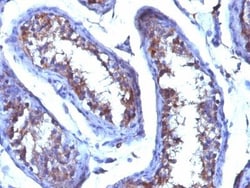
Biotium Progesterone(6-5E-3F), CF568 conjugate, 0.1mg/mL
This MAb is specific for progesterone. It exhibits minimal cross reactivity with related compounds in ELISA. It reacts with Progesterone-11a-HMS-BSA: 100%; 5-beta-Pregnane-3,20-dione: 48%; 5-alpha-Pregnane-3,20-dione: 26.4%; 17-alpha-Hydroxyprogesterone: 2.5%; 20-alpha-Hydroxyprogesterone: 0.04%. Progesterone is a steroid hormone synthesized from the cholesterol derivative, pregnenolone, in the cortex of the adrenal gland. Progesterone is secreted by the corpus luteum and acts to prepare the endometrium for the implantation of a fertilized egg. During pregnancy, it is secreted by the placenta to prevent spontaneous abortion and to stimulate the development of mammary tissue to produce milk. Thus, progesterone plays a central role in the reproductive events associated with the establishment and maintenance of pregnancy. Luteinized theca cells of normal ovary secrete progesterone. The determination of progesterone concentrations in the body fluids is of great value for endocrin

Electron Microscopy Sciences Aurion ImmunoGold Donkey-Anti-Goat, IgG, EM-grade 25nm 3.5 ML
It is impossible to perform a double labeling experiment in combination with, for instance a mouse primary antibody, since applicable secondary antibodies are either raised in rabbit or goat. To overcome this difficulty the Aurion Series of Secondary ImmunoGold conjugates is based on antibodies raised in Donkey, including Donkey-anti-Goat. It is then known that mixing Donkey-anti-Goat and Donkey-anti-Mouse provides a successful solution.
Particle size: EM-grade 25nm
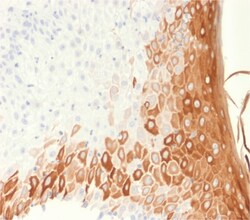
Biotium Cytokeratin 10 (Suprabasal Epithelial Marker) (rKRT10/1275), CF568 conjugate, 0.1mg/mL
This MAb recognizes a protein of 56.5 kDa, identified as cytokeratin 10 (CK10). CK10 is expressed in all suprabasal layers of the epidermis. In the epidermis, expression of CK10 strictly parallels the extent of differentiation; it is absent in the basal layer, appears in the first suprabasal layers and increases in concentration towards the granular layer. However, CK10 is rarely detected in early stages of vulvar squamous carcinomas (tumors less than 2 cm, clinical stage I) regardless of the tumor grade. In larger and more advanced tumors (greater than 2 cm, clinical stages II and III), CK10 is detected very frequently. Expression of CK10 is related to maturation of malignant keratinocytes, being preferentially detected in more-differentiated parts.Primary antibodies are available purified, or with a selection of fluorescent CF Dyes and other labels. CF Dyes offer exceptional brightness and photostability. Note: Conjugates of blue fluorescent dyes like CF405S and CF405M
Miltenyi Biotec, Inc. aTCRg/d-PerCP-Vio700, m, REA633, 500 t
Identification and enumeration of TCRγ/δ+ cells by flow cytometry.
This product is subject to the following: Miltenyi Biotec, Inc. Terms and Conditions of Sale For Products and Services
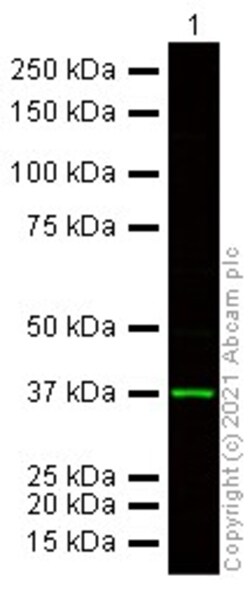
Abcam Donkey Anti-Goat IgG H&L Alexa Fluor 790
Donkey Anti-Goat IgG H&L Alexa Fluor 790
The product is subject to the following: Abcam Restricted Use Statement
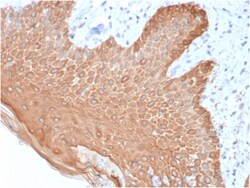
Biotium Cytokeratin, Multi (Epithelial Marker)(rKRT/457), CF568 conjugate, 0.1mg/mL
Twenty human keratins are resolved with two-dimensional gel electrophoresis into acidic (pI 6. 0) subfamilies. This antibody recognizes acidic (Type I or LMW) and basic (Type II or HMW) cytokeratins, including 59 kDa (CK4); 58 kDa (CK5); 56 kDa (CK6); 52 kDa (CK8); 56. 5 kDa (CK10); 53 kDa (CK13) and 45 kDa (CK18). This is a broad-spectrum antibody, which has been reported to differentiate epithelial tumors from non-epithelial tumors. Many studies have shown the usefulness of keratins as markers in cancer research and tumor diagnosis. Primary antibodies are available purified, or with a selection of fluorescent CF Dyes and other labels. CF Dyes offer exceptional brightness and photostability. Note: Conjugates of blue fluorescent dyes like CF405S and CF405M are not recommended for detecting low abundance targets, because blue dyes have lower fluorescence and can give higher non-specific background than other dye colors.
Miltenyi Biotec, Inc. aTCRg/d-PerCP-Vio700, m, REA633, 100 t
Identification and enumeration of TCRγ/δ+ cells by flow cytometry.
This product is subject to the following: Miltenyi Biotec, Inc. Terms and Conditions of Sale For Products and Services
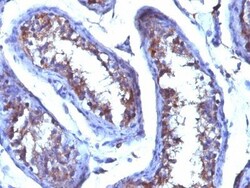
Biotium Progesterone(6-5E-3F), CF568 conjugate, 0.1mg/mL
This MAb is specific for progesterone. It exhibits minimal cross reactivity with related compounds in ELISA. It reacts with Progesterone-11a-HMS-BSA: 100%; 5-beta-Pregnane-3,20-dione: 48%; 5-alpha-Pregnane-3,20-dione: 26.4%; 17-alpha-Hydroxyprogesterone: 2.5%; 20-alpha-Hydroxyprogesterone: 0.04%. Progesterone is a steroid hormone synthesized from the cholesterol derivative, pregnenolone, in the cortex of the adrenal gland. Progesterone is secreted by the corpus luteum and acts to prepare the endometrium for the implantation of a fertilized egg. During pregnancy, it is secreted by the placenta to prevent spontaneous abortion and to stimulate the development of mammary tissue to produce milk. Thus, progesterone plays a central role in the reproductive events associated with the establishment and maintenance of pregnancy. Luteinized theca cells of normal ovary secrete progesterone. The determination of progesterone concentrations in the body fluids is of great value for endocrin
Biotium Cytokeratin 19(A53-B/A2.26), CF568 conjugate, 0.1mg/mL
This MAb reacts with the rod domain of human cytokeratin-19 (CK19), a polypeptide of 40 kDa. Its epitope maps between amino acid 312-335. CK19 is expressed in sweat gland, mammary gland ductal and secretory cells, bile ducts, gastrointestinal tract, bladder urothelium, oral epithelia, esophagus, and ectocervical epithelium. Anti-CK19 reacts with a wide variety of epithelial malignancies including adenocarcinomas of the colon, stomach, pancreas, biliary tract, liver, and breast. Perhaps the most useful application is the identification of thyroid carcinoma of the papillary type, although 50%-60% of follicular carcinomas are also labeled. Anti-CK19 is a useful marker for detection of tumor cells in lymph nodes, peripheral blood, bone marrow and breast cancer.Primary antibodies are available purified, or with a selection of fluorescent CF Dyes and other labels. CF Dyes offer exceptional brightness and photostability. Note: Conjugates of blue fluorescent dyes like CF405S and

Abcam Donkey F(ab) Anti-Goat IgG H&L (HRP).
Donkey F(ab) Anti-Goat IgG H&L (HRP).
The product is subject to the following: Abcam Restricted Use Statement
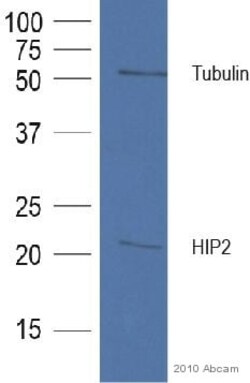
Abcam Donkey Anti-Goat IgG H&L HRp preadsorbed
Donkey Anti-Goat IgG H&L HRp preadsorbed
The product is subject to the following: Abcam Restricted Use Statement

Biotium Secondary Antibody Goat IgG Donkey CF583R 1/EA
This product is prepared by labeling highly cross-adsorbed donkey anti-goat IgG (H plus L) with CF and reg 583R dye To minimize cross-reactivity the antibody has been adsorbed against chicken guinea pig Syrian hamster horse human mouse rabbit and rat serum